Working more efficiently with Polem fertilizer silo
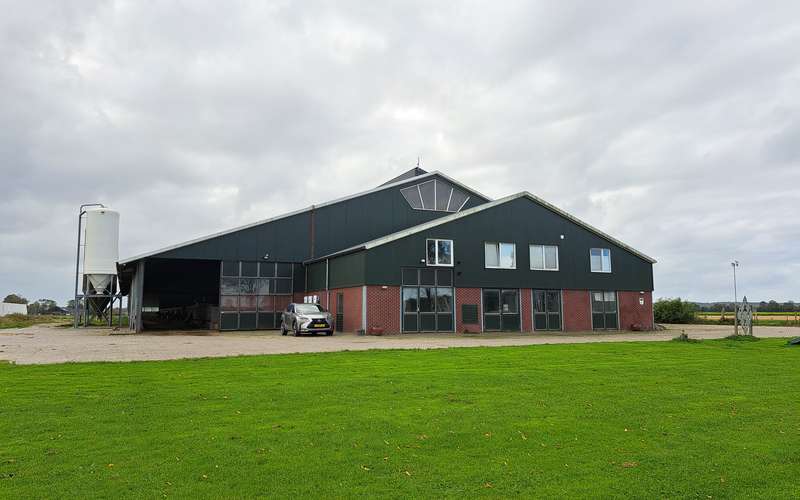
Cees Ruijter, dairy farmer in Warmenhuizen, North Holland, invested in a new Polem fertilizer silo a year and a half ago. “We have been working with this fertilizer silo for two seasons now and it works efficiently: filling is faster, the fertilizer spreader fits well under it and the storage of fertilizer is fine,” says Cees Ruijter.Cees (38), together with his wife and his parents, keeps 170 dairy cows to produce dairy for Beemster cheese, among other things. They farm 110 hectares of land, mainly grassland. From early March until September, the dairy farmer spreads fertilizer on the grassland. For two years, he has been spreading the fertilizer with a Vicon precision spreader. “The new spreader with GPS spreads more precisely. For example, in a sloping field, it automatically spreads narrower so there is no overlap. Better for the environment and for my wallet. However, this spreader is wider than the previous one and did not fit under the old fertilizer silo.”Easy fillingRuijter has now been using the new Polem fertilizer silo with a capacity of 25 cubic meters, good for 27 tons of fertilizer, for two seasons. It is a hopper silo for storing granular fertilizer on a bridge structure. “The old silo was worn out and those legs were sloping. The fertilizer spreader didn't fit straight under it so filling it was more difficult.We filled bigbags with fertilizer to put in the spreader or got the bigbags delivered through the supplier. That took five minutes per bigbag and resulted in a messy yard and a lot of waste. The new silo has straight legs. I drive the fertilizer spreader under it and in half a minute it's filled with two tons of fertilizer.” The new silo has a widening piece so the fertilizer spreader is filled evenly and manual labor is not required.Good winter storageThe Ruijter family's farm is close to the coast. “The humidity is higher here. The fertilizer stored in the silo during the winter runs well out of the silo in the spring. I am very satisfied with it. If you look at the purchase value of the silo compared to the cost of the fertilizer, the investment is not too bad.” Previously, Cees Ruijter also bought fertilizer on pre-sale and had it stored at the supplier. “Now we can store it in the silo in our own yard. This allows us to buy fertilizer on pre-sale at an attractive price,” Cees Ruijter explains.Ruijter has not had any maintenance on the silo yet. The fertilizer silo is also suitable for storing animal manure pellets. “Who knows, we might use the silo for that too in the future. The lifespan of these silos is at least 20-25 years. I think it's a good investment,” concludes Cees Ruijter.
Poultry farmer Landwirt Baumeister happy with horziontal floor silos
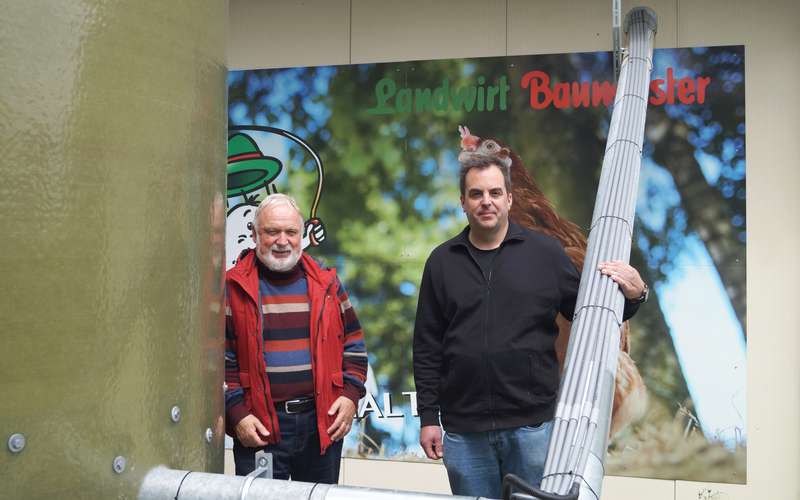
Udo Baumeister and Stephan Werthmann unanimously agree: Polem's horizontal floor silos are an asset to their laying poultry business. The partners jointly own Landwirt Baumeister in Breckerfeld, Germany, a laying poultry farm with egg trading and sales.
Polem tanks ideal for storage of liquid fertilizer
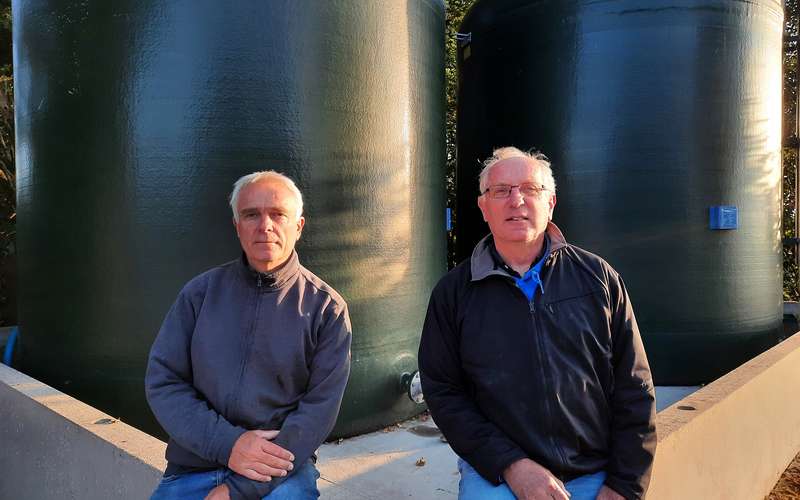
Brothers Hein and Lenus Waalkens invested in two Polem tanks to store liquid fertilizer in 2023. “We are super satisfied with them. Pleasant work, large storage capacity, no maintenance and because of the green color they hardly stand out in the landscape,” says Hein Waalkens.Together with his brother Lenus (60), Hein (63) grows wheat, barley, rapeseed and alfalfa in Nieuwolda, Groningen. They also do agricultural nature management with field edges and bird fields. “We have heavy clay soil here with 65 percent siltability. Cultivation above ground therefore works best,” Hein explains.
Raiffeisenagrar Ankum installed composite silos
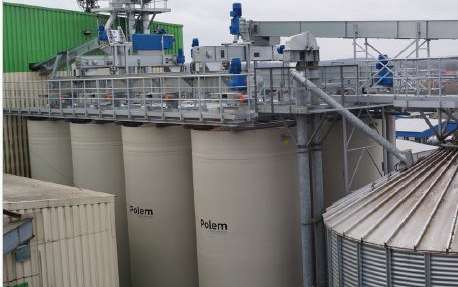
In 2023, Raiffeisenagrar installed eight Polem composite silos at its feed production site in Ankum. “The difficult flowing raw materials such as turnip and soybean meal flow easily out of these silos. The silos stay clean and work fine,” said Thorsten Kühl, operations manager of the feed mill in Lower Saxony, Germany.Kühl is also super satisfied with the cooperation with Polem. The feed mill has been using the silos since spring 2023. “After a year, we can say that we dare to store everything in these silos. Difficult flowing products such assoybean and rape meal are unloaded effortlessly. The product flows like a column to the output. Even chocomeel, cocoa with a flour component, I dare to store in it,” says Thorsten Kühl. He has not had any jammed products in the composite silos in the past year. “There is a hammer ban here,” Thorsten Kühl says with a laugh. A hammer is also absolutely unnecessary. The silos are equipped with a vibrating floor to facilitate product unloading.Steep outflow angleRaiffeisenagrar installed eight composite silos of 160 m³ capacity each. Between the building and the steel silos, the eight composite silos do stand out. They are a total of 26 meters high and have a diameter of 3.48 meters. Special features are the funnel outlet angles of 30 degrees which corresponds to a slope of 75 degrees. This absolutely guarantees mass flow. “This is exceptionally steep. As standard, this angle is 60 degrees,” explains Richard van Lierop, Polem account manager. Thorsten Kühl wanted absolute guarantee of good flow. He is pleased with the decision for the 30-degree angle. “Our experience is 100 percent first in - first out without de-mixing of products. If the product drops down like a column, you don't get any segregation.” A system of chain conveyors fills the silos from the top.In 2014, the operations manager came into contact with Polem. “Thorsten Kühl was urgently looking for a tank for storing molasses, also a product with very specific requirements. We were then able to quickly produce and deliver that tank,” says fellow account manager Sjouke Miedema who, as account manager, maintained contact with Raiffeisenagrar.Building for the futureThorsten Kühl: “We started planning in 2013 how we wanted to make the feed mill ready for the future. We no longer wanted steel silos. They are not nice and smooth and something always sticks to the walls. We liked Polem's first composite silo and I was impressed with the quality.” In consultation with the cooperative's management and board, he was given a free hand to start implementing the plans. Together with Sjouke Miedema and engineers from Polem, he worked out the plans. They visited similar projects. By 2018, everything was concrete. In total, the entire modernization involves an investment of 2.5 million euros which includes the eight silos with supply and disposal facilities, electricity, the spacious platform and installation. A big investment but Polem silos guarantee 30 years of intensive use. Sjouke Miedema: “In practice, we see that our silos last 40 years and more.”Preperation“If you put a lot of time into preparation beforehand, you get a good end result,” says Sjouke Miedema. In the run-up to the project, he had a lot of contact with Thorsten Kühl and his team. Knowledge from both sides, the operational of the feed mill and the specific knowledge from Polem, is essential in the preparatory phase. “Nothing is more annoying than saying afterwards, if only we had done it differently,” the account manager knows. The feed manufacturer had consultations with Polem's account manager, project manager and engineers who also came to see the situation on site. “Consultation about width, height, bearing capacity, load on the silo, technical connections, integration of the silos in the factory, anchoring points; all these points require quite a bit of preparation. Once the silo is made in the hall in Lemmer, change is radical. Polem provided 3D drawings of the silos in advance for integration into the factory. “We do that to check 100 percent that the dimensions are correct and, for example, you don't get a conflict with the steel structures or the transport systems,” Sjouke Miedema explains.InstallationDue to good preparation, the eight silos were installed in 1.5 days. “We had a crane here at the construction site that we could use for this. If not that you have to rent a mobile crane for installation,” said Thorsten Kühl.He is very pleased with the cooperation with Polem. “They are always there for us, either Sjouke or one of his colleagues. The aftercare is also perfect; it's not deliver and go. That works very nicely.” The silos stay very clean inside. “Some products have a self-cleaning ability. Occasionally we put a load of unground corn or grain through them. That cleans the inside,” says Thorsten Kühl. The outside of the silos are still very clean after a year. A wash every few years is sufficient.
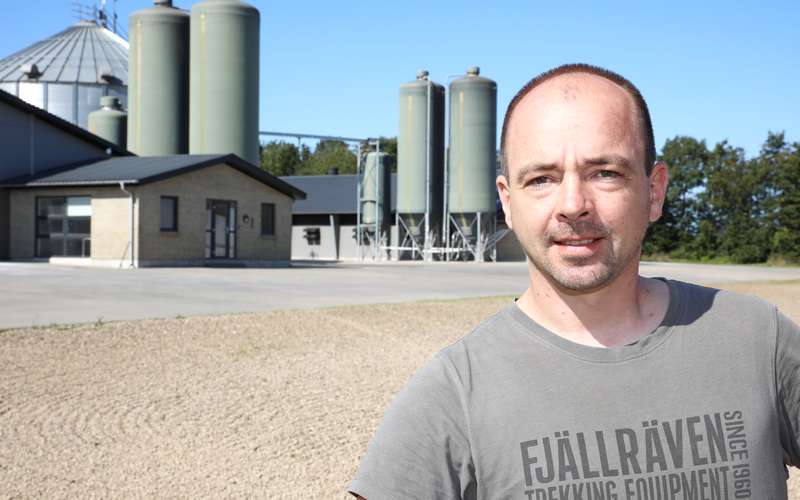
"Very satisfied! No problems with the Polem silos and they are easy to clean"
Rune Thomsen is manager of a broiler farm, the Williamsborg estate in Denmark. The company grows wheat, barley, rapeseed and peas on more than 1,000 hectares. They also have 110,000 broiler chickens.In 2015, an outdated pig farm was acquired that was in urgent need of renovation. The old stables were dismantled, leaving a blank canvas for the future of the farm. Over the next two years, 2015 and 2016, two impressive, identical sheds emerged from the dust and ruins. These new buildings were intended to house up to 55,000 broilers each, and they promised a new era for the company. Surrounding these shiny new sheds are a total of six impressive broiler feed silos from the renowned Polem brand. Four of these silos have a generous capacity of 60 cubic meters, while the remaining two have a slightly more modest capacity of 13 cubic meters. These smaller silos are used as buffer storage for their own wheat which is mixed with the feed coming from the factory. Equipped with top and bottom sensors they are automatically filled from the bigger storage behind them. Due to current wheat prices this is not in use at the time, but it works really well and will be used again in the future. The seamless construction of the silos eliminates potential weak points, safeguarding the stored feed against contaminants and maintaining optimal storage conditions.The manager, Rune Thomsen, showed approval as he spoke: "Very satisfied! No problems at all with these silos, and they were easy to clean in a recent case of salmonella." Another great benefit, These silos are designed to endure the test of time, ensuring that the investment yields returns for years to come.The sheds on this typical Danish poultry farm, each with an area of approximately 3,000 square meters, followed the well-known pattern of broiler farming. Feeding lines, an ingenious combined system for ridge and longitudinal ventilation, inlet valves, six water lines and a generous amount of thick litter provided the optimal environment for the chicks.
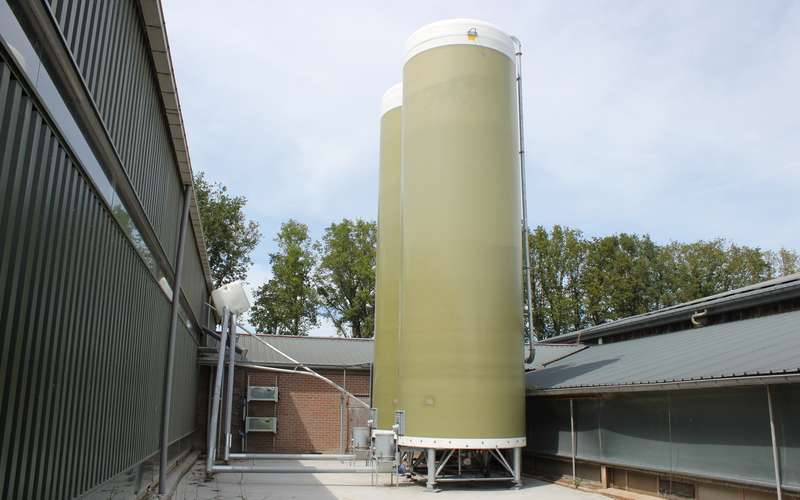
"No segregation and the feed never sticks"
Harm Rijkers has been working with two Polem horizontal floor silos since July 2021. After using them for a year, he shares his experiences: “The horizontal floor silos are fine. The feed never sticks and there is much less segregation.”When we set up our new floor barn for one-star Better Life hens in 2020, we wanted a feeding system that was efficient, reliable and low maintenance. Our existing hopper silos were working fine, but in humid weather, feed would sometimes stick and cause segregation. On the advice of our Polem dealer, we decided to make the switch to two horizontal floor silos. We have been working with them since July 2021 and the results speak for themselves: the feed never sticks, the feed flow is constant and segregation is a thing of the past.The horizontal floor silos of 70 m³ each are equipped with a robust discharge system with sweeping auger. This ensures that the feed sinks down evenly and no bridging occurs. The “first in, first out” principle ensures that the oldest feed is used first, contributing to consistent feed quality. At the end of the laying round, the silo must be completely empty. Thanks to the clever construction and the manhole at the auger, this is easy to achieve.The silos also have great advantages in terms of ease of use. They are equipped with weighing bars, which allow us to see exactly how much feed is left in them via our cell phone. This makes ordering new supplies more efficient and prevents waste. In addition, the Aircleaner system helps fill the silos, so the feed truck driver does not have to use a dust bag. Even though the silos are placed out of sight behind the egg room, filling runs smoothly.We are extremely satisfied with our Polem horizontal floor silos. They contribute to a more efficient and labor-friendly operation, exactly as we envisioned. Thanks to the reliable feed flow, less segregation and the extra ease of use, this is an investment that absolutely pays for itself. I would definitely recommend these silos to other poultry farmers!